Siege of Sevastopol — Romanian Contribution(1942)
Approximate site. The pin marks a locally accepted site or a nearby anchor point, not a survey-grade position.
Sevastopol city/fortress, Crimea
Coordinate source: Standard GPS Sevastopol
Background
The Soviet naval base at Sevastopol was one of the strongest fortifications in the world. Its site, on a deeply eroded, bare limestone promontory at the southwestern tip of the Crimea, made an approach by land forces exceedingly difficult. The high-level cliffs overlooking Severnaya Bay protected the anchorage, making an amphibious landing just as dangerous. The Soviet Navy had built upon these natural defenses by modernizing the port and installing heavy coastal batteries consisting of 180mm and 305mm re-purposed battleship guns which were capable of firing inland as well as out to sea. The artillery emplacements were protected by reinforced concrete fortifications and 9.8-inch thick armored turrets. The port was a valuable target. Its importance as a potential naval and air base would enable the Axis to conduct far-ranging sea and air operations against Soviet targets into and over the Caucasus ports and mountains. The Red Air Force had been using the Crimea as a base to attack targets in Romania since the Axis invasion in June 1941, proving its usefulness as an air base. Likewise, the Wehrmacht had launched a bombing raid on the Sevastopol naval base at the start of the invasion.
Campaign: Eastern Front 1942-43
Forces Engaged
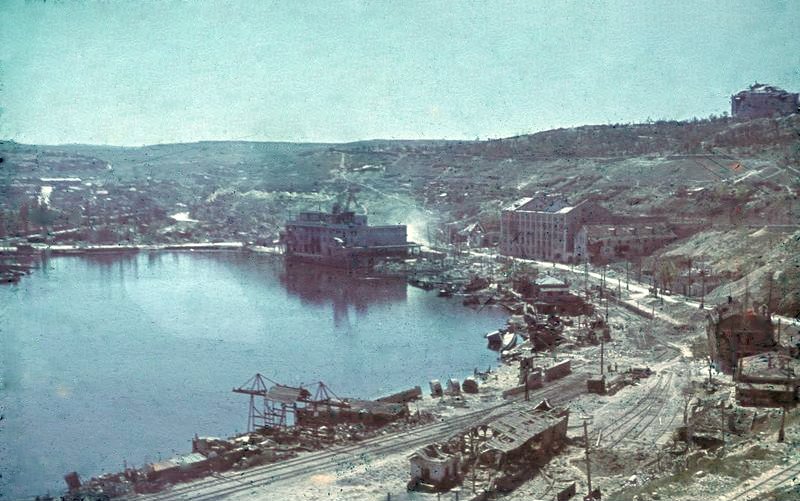
The Battle
Romanian 1st Mountain Division and 18th Infantry Division stormed the outer fortification ring. Romanian sappers breached Fort Maxim Gorky.
The siege of Sevastopol, also known as the defence of Sevastopol (Russian: Оборона Севастополя, romanized: Oborona Sevastopolya) or the Battle for Sevastopol (German: Schlacht um Sewastopol; Romanian: Bătălia de la Sevastopol; Russian: Битва за Севастополь, romanized: Bitva za Sevastopol'), was a military engagement that took place on the Eastern Front of the Second World War. The campaign was fought by the Axis powers of Germany and Romania against the Soviet Union for control of Sevastopol, a port in Crimea on the Black Sea. On 22 June 1941, the Axis invaded the Soviet Union during Operation Barbarossa, with Axis land forces reaching the Crimean peninsula in the autumn of 1941 and overrunning most of the area.
“"The Romanians in the mountains were masters of the silent approach. We would wake to find they had taken positions we thought impregnable." — German NCO, 11th Army, cited in Axworthy
Casualties & Outcome
1,597 killed, 6,571 wounded, 286 missing (Romanian: 8,454 total); ~35,866 total Axis; ~18,000 killed, ~95,000 captured (Soviet)
Romania / Germany achieved victory over Soviet Union.
Sevastopol fell on July 4, ending Soviet control over Crimea. The Romanian Mountain Corps gained the highest reputation for war. Manstein was promoted to the rank of Field Marshal.
Historical Record


Significance & Legacy
Romania received captured Soviet naval vessels as reward. Peak of Axis cooperation.
The second and last Golden Krimschild was awarded to Manstein himself, on 24 November 1942.The Mount Sapun memorialFrom 2 June to 3 July 8 Air Corps had flown 23,751 sorties and dropped 20,528 tons of bombs.
Frequently Asked Questions
- When was the Siege of Sevastopol — Romanian Contribution?
- The Siege of Sevastopol — Romanian Contribution took place in 1942. Jun 7–Jul 4, 1942.
- What was the outcome of the Siege of Sevastopol — Romanian Contribution?
- The Romania / Germany were victorious against the Soviet Union.
- What was the significance of the Siege of Sevastopol — Romanian Contribution?
- Romania received captured Soviet naval vessels as reward. Peak of Axis cooperation.