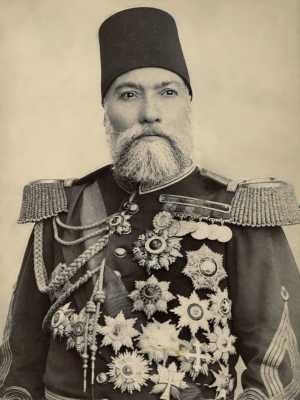
In July 1877, the Russian Army, under the command of Grand Duke Nicholas, moved toward the Danube River virtually unopposed, as the Ottomans had no sizable force in the area. The Ottoman high command sent an army under the command of Osman Nuri Pasha to reinforce Nikopol, but the city fell to the Russian vanguard in the Battle of Nikopol (16 July 1877) before Osman reached it. He settled on Plevna, a town among vineyards in a deep rocky valley some twenty miles to the south of Nikopol, as a defensive position. The Ottomans quickly created a strong fortress, raising earthworks with redoubts, digging trenches, and quarrying out gun emplacements. From Plevna Osman's army controlled the main strategic routes to the Balkan Mountains. As the Turks hurried to complete their defenses, Russian forces began to arrive.
Campaign: Russo-Turkish War 1877–78
Forces Engaged
Romanian troops storming the Grivitsa redoubt during the Romanian War of Independence of 1877–1878 fought against the Ottoman Empire. The event took place on 30 August 1877. (c. 1881) — Henryk Dembitzky (1830-1906). Public domain.
Victor
Romania & Russia
Commander: Prince Carol I
Strength:100,000
Defeated
Ottoman Empire
Commander: Osman Pasha
Strength:50,000
The Battle
The Last Battle at Plevna, November 28, 1877 — oil painting (c. 1889) — Nikolai Dmitriev-Orenburgsky (1889). Public domain.
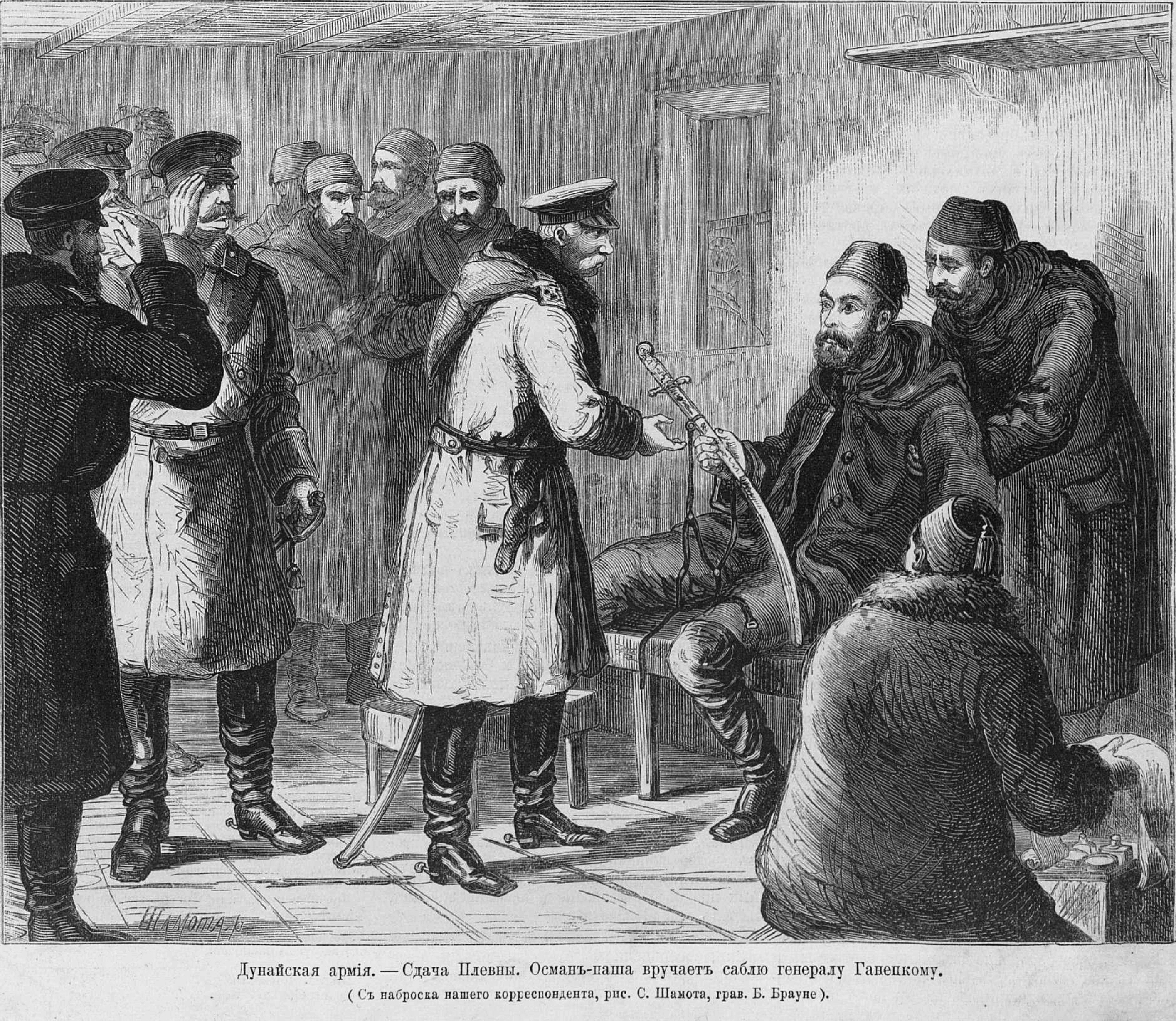
"I surrender to the young and brave Romanian army" — Osman Pasha to Colonel Cerchez.
The siege of Plevna or Pleven, was a major battle of the Russo-Turkish War of 1877–1878, fought by the joint army of the Russian Empire and the Kingdom of Romania against the Ottoman Empire. After the Russian army crossed the Danube at Svishtov, it began advancing towards the centre of modern Bulgaria, with the aim of crossing the Balkan Mountains to Constantinople, avoiding the fortified Turkish fortresses on the Black Sea coast. The Ottoman army led by Osman Pasha, returning from Serbia after a conflict with that country, was massed in the fortified city of Pleven, a city surrounded by numerous redoubts, located at an important road intersection.
“"Tell General Skobelev that only death can free the Russian officer from his word." — Major Fyodor Gortalov, refusing to retreat during the August 30 assault
Romania & Russia achieved victory over Ottoman Empire.
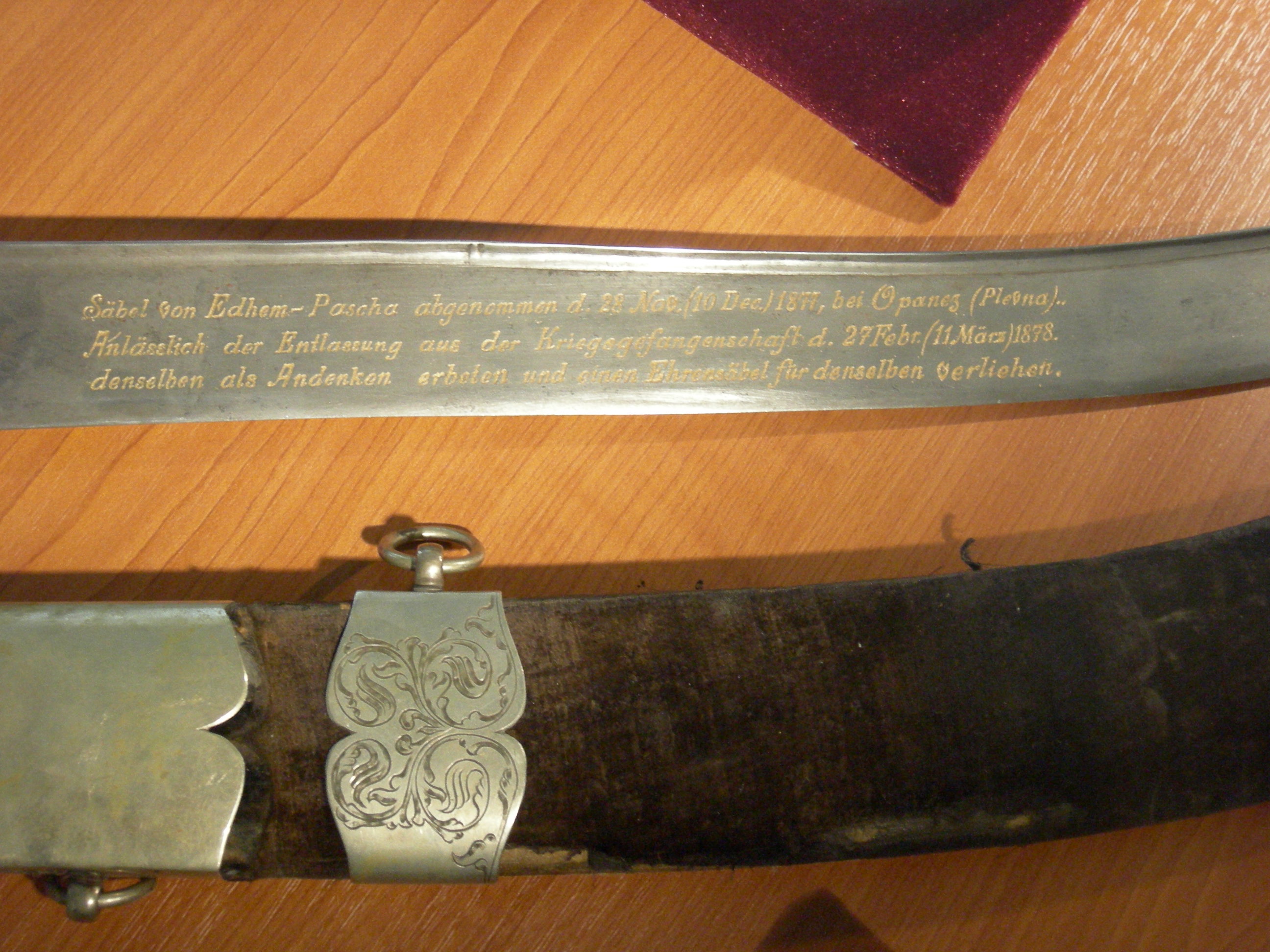
240px|Sword surrendered by Edhem Pasha after the defeat at Plevna. 300px|The Plevna Chapel on St Elijah's Square in Moscow, opened in 1882, commemorates the Russian soldiers who died in the Battle of Plevna. The siege of Plevna seriously delayed the main Russian advance into Bulgaria, but its end freed up Russian reinforcements, which were sent to General Joseph Vladimirovich Gourko, who then decisively defeated the Ottoman forces in the Fourth battle of Shipka Pass. The siege was widely reported and followed by the public in Europe and beyond. Although the declining Ottoman Empire was by this time often regarded as "the sick man of Europe", its five-month-long resistance against a much larger army earned a degree of admiration, which may have contributed to the unsympathetic treatment of Russia at the Congress of Berlin.
Historical Record
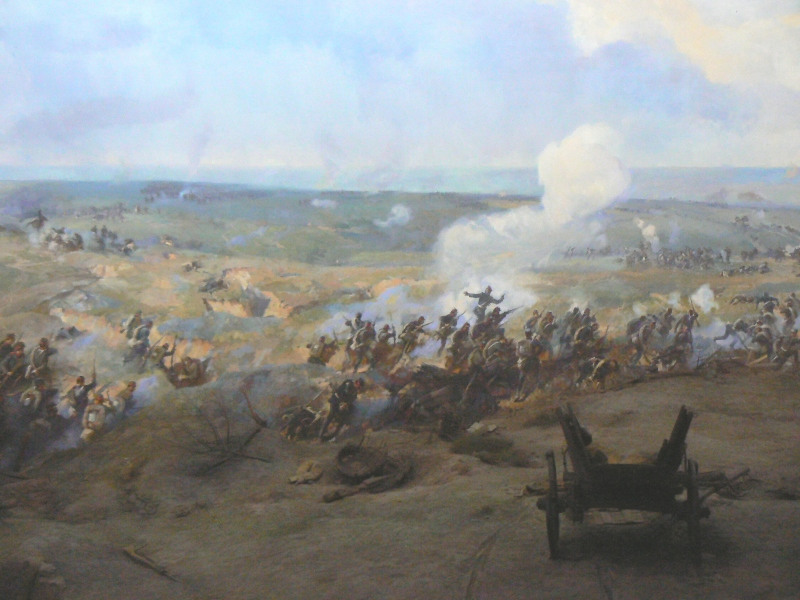
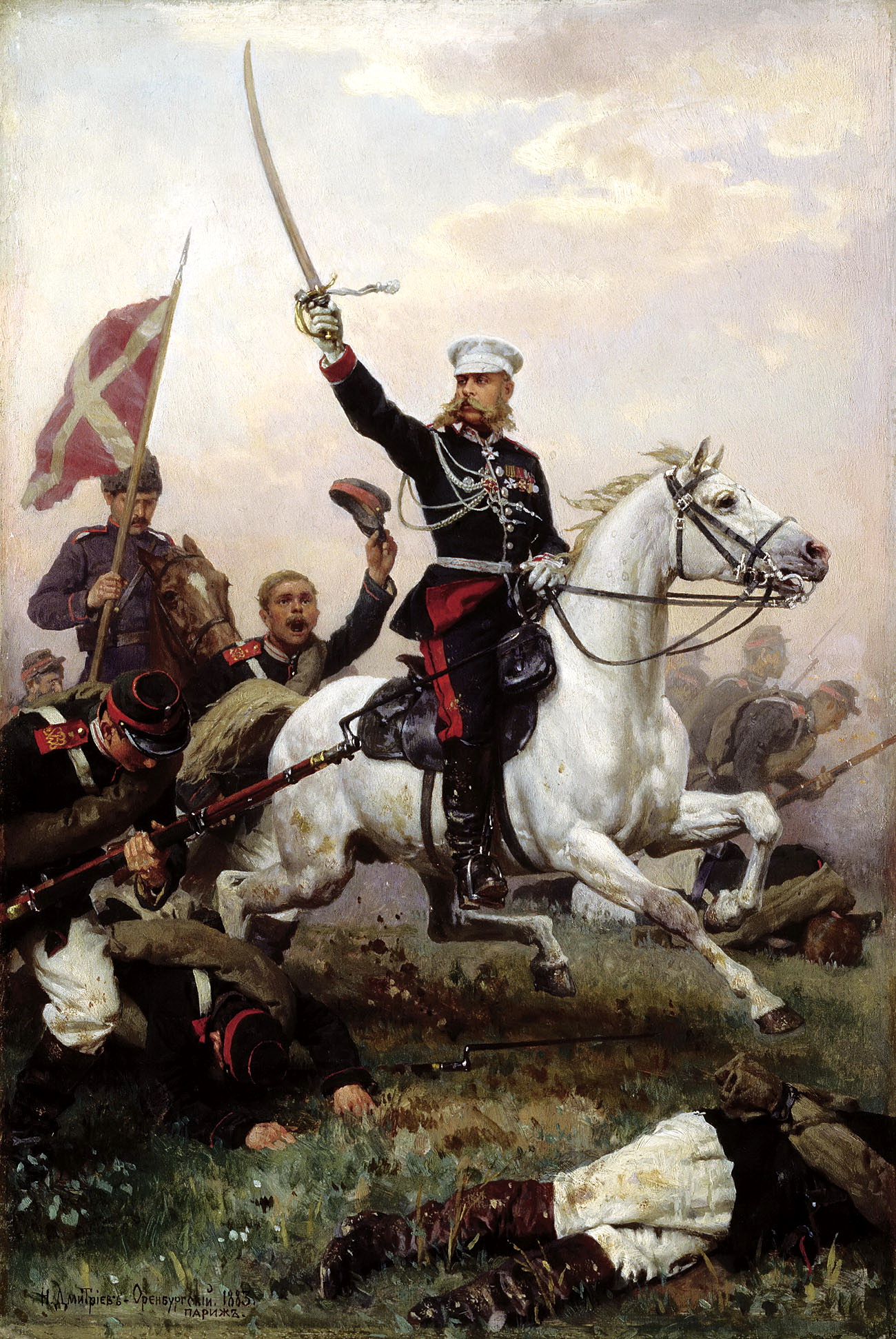
Taking of the Grivitsa Redoubt — Romanian and Russian troops storm Ottoman fortifications (c. 1885) — Nikolai Dmitriev-Orenburgsky (1885). Public domain.Convoy of Ottoman prisoners — field sketch by Nicolae Grigorescu at Plevna (c. 1877) — Nicolae Grigorescu (1877–1878). Public domain.Map of the First Attack on Plevna, July 20, 1877 (c. 1877) — L.G. Beskrovny, Atlas of Russian Military History. Public domain.19th-century postcard of Pleven Monument on Old Square in Moscow. (c. 1896) — В стиле Пётр Петрович Павлов. Public domain.Осман-паша вручает саблю генералу И. В. Ганецкому, 1877 год (c. 1877) — Рис. С. Шамота, грав. Б. Брауне. Public domain.Sword surrendered by Ethem Pasha after the Siege of Pleven. Inscription, in German, reads "Säbel von Edhem-Pascha abgenommen d. 28 Nov. (10 Dec.) 1877, bei Oponez (Plevna).. Anlässlich der Entlassung (c. 2006) — Joe Mabel. CC BY-SA 3.0.Three Romanian soldiers of the 1877-1878 Romanian War of Independence, with an Ottoman flag captured during the Siege of Plevna (20 July – 10 December 1877). Print from the front page of newspaper Res (c. 1877) — Resboiul. Public domain.Monument for the Siege of Pleven 1877, erect in Moscow in 1888. (c. 2008) — Ikar.us (talk). CC BY 3.0.Photo from the Panorama "Pleven epopee 1877", Pleven, Bulgaria (c. 2007) — Vassia Atanassova - Spiritia. Public domain.Danilov, M.P. major general — Svilen1970. Public domain.Gantsky, lieutenant general — Svilen1970. Public domain.A cabinet card of Osman Nuri Pasha of the Ottoman Empire, by Abdullah Frères of Constantinople in about 1890-95. Owned by and scanned and retouched by Tim Ross, who releases all rights. (c. 1890) — Abdullah frères. Public domain.Diorama of the Battle of Plevna from the Military Museum, Bucharest, Romania. The artillery piece is a model of a German-made Krupp 8 cm Stahlkanone C/64. (c. 2006) — Joe Mabel. CC BY-SA 3.0.Dmitriev 004 — related to Siege of Plevna (1877) (c. 1880) — Nikolai Dmitriev-Orenburgsky. Public domain.General Skobelev (Dimitriev-Orenburgsky) — related to Siege of Plevna (1877) (c. 1883) — Nikolai Dmitriev-Orenburgsky. Public domain.Monument for the Siege of Pleven 1877, erect in Moscow in 1888. (c. 2008) — Ikar.us (talk). CC BY 3.0.Photo from the Panorama "Pleven epopee 1877", Pleven, Bulgaria (c. 2007) — Vassia Atanassova - Spiritia. Public domain.Danilov, M.P. major general — Svilen1970. Public domain.Gantsky, lieutenant general — Svilen1970. Public domain.A cabinet card of Osman Nuri Pasha of the Ottoman Empire, by Abdullah Frères of Constantinople in about 1890-95. Owned by and scanned and retouched by Tim Ross, who releases all rights. (c. 1890) — Abdullah frères. Public domain.Diorama of the Battle of Plevna from the Military Museum, Bucharest, Romania. The artillery piece is a model of a German-made Krupp 8 cm Stahlkanone C/64. (c. 2006) — Joe Mabel. CC BY-SA 3.0.Dmitriev 004 — related to Siege of Plevna (1877) (c. 1880) — Nikolai Dmitriev-Orenburgsky. Public domain.General Skobelev (Dimitriev-Orenburgsky) — related to Siege of Plevna (1877) (c. 1883) — Nikolai Dmitriev-Orenburgsky. Public domain.
Significance & Legacy
The fall of Plevna broke Ottoman resistance and led directly to Romanian independence.
Frequently Asked Questions
When was the Siege of Plevna?
The Siege of Plevna took place in 1877. Jul–Dec 1877.
Who won the Siege of Plevna?
The Romania & Russia were victorious against the Ottoman Empire.
What was the significance of the Siege of Plevna?
The fall of Plevna broke Ottoman resistance and led directly to Romanian independence.