Battle of Nagyszeben (Sibiu) 1916(1916)
Exact site. The pin marks a documented battlefield location rather than a broad area.
Sibiu (Nagyszeben)
Coordinate source: latitude.to Sibiu 45.7928, 24.1521
Background
Romania had advanced deep into Transylvania in late August–September while simultaneously facing Bulgarian–German attacks in Dobruja. Falkenhayn specifically arrived from the Western Front with the mandate to destroy the Romanian threat. His swift counter-offensive exploited Romanian over-extension.
Campaign: Transylvanian Campaign 1916
Forces Engaged

The Battle
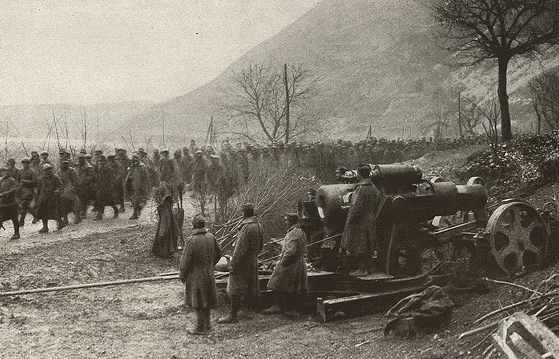
Falkenhayn's counter-offensive struck the Romanian 1st Army south of Sibiu. After four days of heavy fighting in mountain foothills, Romanian forces retreated through Carpathian passes back into Wallachia.
The Battle of Nagyszeben was a World War I military engagement fought between the forces of the Central Powers (Germany and Austria-Hungary) on one side and the forces of Romania on the other side. It was the decisive engagement during the Battle of Transylvania, and also the largest, involving four armies out of the five fighting in the region: two Romanian, one German, and one Austro-Hungarian. German General Erich von Falkenhayn planned to surround and annihilate the entire I Corps of General Ioan Culcer's Romanian 1st Army.
“"Falkenhayn attacked with the precision of a surgeon — he found the joint between our divisions and drove straight through it. We had no reserves. The retreat through Red Tower Pass was the worst thing I witnessed in four years of war." — Romanian 1st Army staff officer, September 1916
Casualties & Outcome
~10,000 total killed, wounded, captured (Romania); ~5,000 total (Germany / Austria-Hungary)
Germany / Austria-Hungary achieved victory over Romania.
Romanian Army 1 retreated through the Red Tower Pass and Vulcan Pass. Sibiu was recaptured by German forces. Falkenhayn's counteroffensive gained momentum, putting all Romanian forces in Transylvania on the defensive.
Historical Record


Significance & Legacy
First major German victory in Transylvania. Marked the beginning of Romania's disastrous autumn retreat from Transylvania, reversing all gains made since August 27.
Hermannstadt was an undeniable defeat, but it was never a rout, and the retreat over the range will rank as one of the most honourable achievements in the story of Rumanian arms. It was faulty generalship which led to the surprise of 26th September, but both leaders and men showed at their best in their efforts to retrieve the disaster. In consequence, the Romanian troops which defeated the first Central Powers offensive south of the Red Tower Pass in late October were those beaten at Nagyszeben in September.
Frequently Asked Questions
- When was the Battle of Nagyszeben (Sibiu) 1916?
- The Battle of Nagyszeben (Sibiu) 1916 took place in 1916. Sep 26–29, 1916.
- What was the outcome of the Battle of Nagyszeben (Sibiu) 1916?
- The Germany / Austria-Hungary were victorious against the Romania.
- What was the significance of the Battle of Nagyszeben (Sibiu) 1916?
- First major German victory in Transylvania. Marked the beginning of Romania's disastrous autumn retreat from Transylvania, reversing all gains made since August 27.