HomeAll BattlesHistorical Periods
  1. Home
  2. ›
  3. Early Modern Era
  4. ›
  5. Battle of Verbia

Battle of Verbia(1561)

Explore on Interactive Map
Nov 18, 1561·Iacob Heraclid (Despot) & Olbracht Łaski victory·land·open field

Background

Heraclid (or Heraclid Despot), an adventurer and forger of Greek Maltese origin, depicted himself as, among other things, a nephew of Stephen the Great. His various links with Moldavia included accounts about his father, John Heraclides. According to Iacob's own account, John had been killed on Moldavian territory, possibly at Hârlău. He blamed this execution on either the Ottomans or on Prince Ștefăniță (reigned 1517–1527). The pretender built up his career as a mercenary from 1553, when he became a military expert for the Reichsarmatur, seeing action during the war in Flanders. In late 1555, he became an Imperial Count Palatine. Heraclid's parallel career was as a religious polemicist and preacher. His involvement with the Reformation began ca. 1554, when he met Philip Melanchthon; he was prompted to consider designs for a unification between the Protestant and Orthodox faiths, and came to view Moldavia as a stepping-stone toward that ultimate goal. While spreading the faith in Poland, he moved away from mainline Lutheranism, embracing Calvinism and finally Nontrinitarianism, though he remained discreet about his personal religion.

Forces Engaged

Effigy of Iacob Heraclid (Despot Vodă) on his 1563 Moldavian thaler. Based on outline in Enciclopedia României, 1938 ed., which is public domain.
Effigy of Iacob Heraclid (Despot Vodă) on his 1563 Moldavian thaler. Based on outline in Enciclopedia României, 1938 ed., which is public domain. (c. 2018) — Dahn. CC BY-SA 4.0.
Victor
Iacob Heraclid (Despot) & Olbracht Łaski
Commander: Iacob Heraclid
Strength: 2,000 (est.)
Defeated
Principality of Moldavia
Commander: Prince Alexandru Lăpușneanu
Strength: 25,000 (est.)

The Battle

Historical depiction related to Battle of Verbia (1561) — early modern conflict in the Romanian lands
Historical depiction related to Battle of Verbia (1561) — early modern conflict in the Romanian lands (c. 1561) — Bogdan Molea. Public domain.

Heraclid's army, equipped with Spanish arquebusiers, defeated the Moldavian force after the cavalry commander Moțoc defected to the enemy during battle. Heraclid usurped the Moldavian throne.

The Battle of Verbia was the decisive episode in Iacob Heraclid (Despot)'s invasion of Moldavia, taking place on November 18, 1561. Heraclid and Olbracht Łaski's army was backed by the Holy Roman Empire and possibly also by the Knights Hospitaller; it comprised foreign mercenaries, including Spaniards armed with arquebuses, making this the first battle in Moldavian history to be won by superior firepower. The Moldavian military forces under Prince Alexandru Lăpușneanu were backed by Janissaries, but lost crucial support from the cavalry when commander Ion Moțoc defected to the enemy. From the village of Verbia, located outside Dimăcheni, Heraclid's Hungarian troops stormed into Botoșani, slaughtering the surviving Janissaries.

Casualties & Outcome

Iacob Heraclid (Despot) & Olbracht Łaski achieved victory over Principality of Moldavia.

Bălcescu analyses Verbia as evidence that the Moldavian people had ceased fighting "for its nationhood and its liberty", meaning that their "progress in the military art" had entered standstill. As he notes, Lăpușneanu, "for all the numerical superiority of his army, for all the personal courage he showed, lost [at Verbia], being uneducated on how to make proper use of his artillery, unwilling to go on the offensive at the right time, and providing a limp defense once he was under attack." Victory at Verbia gave Despot control over most of Moldavia, though there were still other noted clashes. Ten days after the battle, 260 Janissaries had barricaded themselves in the inner courtyards of Botoșani.

Historical Record

Portrait of Michael the Brave (Mihai Viteazul), who briefly united the three Romanian principalities (1600)
Portrait of Michael the Brave (Mihai Viteazul), who briefly united the three Romanian principalities (1600) (c. 1601) — Anonymous painter (17th century). Public domain.
Map showing the approximate invasion route taken by the armies of Iacob Heraclid Despot and Olbracht Łaski's mercenary army during their November 1561 invasion of northern Moldavia; with localization
Map showing the approximate invasion route taken by the armies of Iacob Heraclid Despot and Olbracht Łaski's mercenary army during their November 1561 invasion of northern Moldavia; with localization (c. 2019) — Dahn. CC BY 4.0.
Royal banner used during the reign of the House of Vasa over the Polish-Lithuanian Commonwealth.
Royal banner used during the reign of the House of Vasa over the Polish-Lithuanian Commonwealth. (c. 2024) — 117-M-I-K-E, with assets by Sodacan, Heralder, Odejea, and Thetaspilt.. CC BY-SA 4.0.
Coat of arms Korab of polish noble families
Coat of arms Korab of polish noble families (c. 2009) — Projekt graficzny: Tadeusz Gajl, POL_COA_blank.svg: Tadeusz Gajl, vector version: Bastianow, Charg. CC BY-SA 3.0.
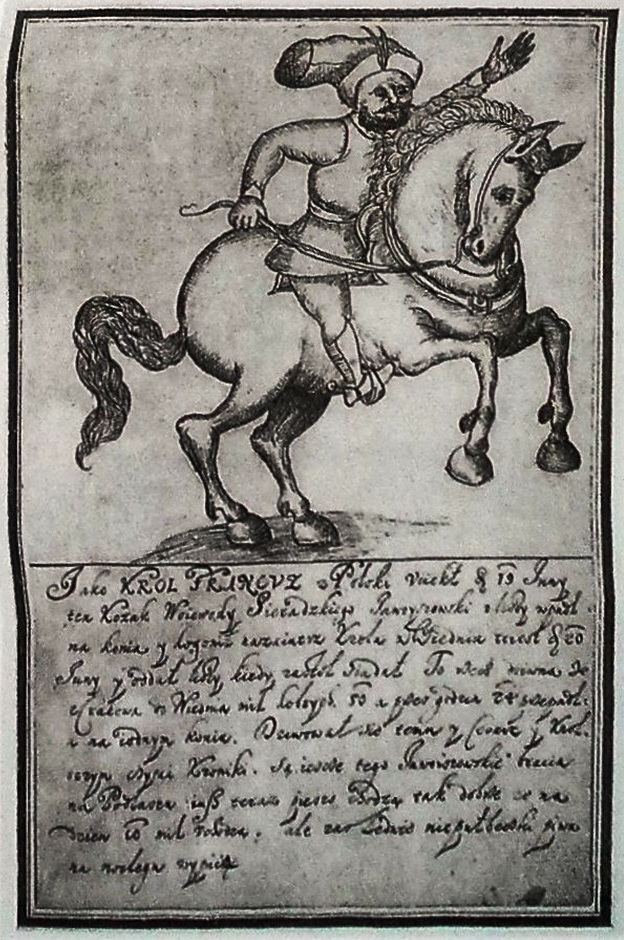
Явойшовский - казак на службе Альбрехта Лаского, фототипия по гравюре 16 в.
Явойшовский - казак на службе Альбрехта Лаского, фототипия по гравюре 16 в. (c. 1587) — Template:Author:unknown. Public domain.
Banner of the Holy Roman Empire, double headed eagle without haloes (1400-1806)
Banner of the Holy Roman Empire, double headed eagle without haloes (1400-1806) (c. 1400) — David Liuzzo, eagle by N3MO (re-uploaded by Dragovit). CC BY-SA 3.0.
Lapusneanu — related to Battle of Verbia (1561)
Lapusneanu — related to Battle of Verbia (1561) — Unknown. Public domain.
Coat of arms of Wallachia, engraving above a dedication by Prince "Peter" (Radu Paisie).
Coat of arms of Wallachia, engraving above a dedication by Prince "Peter" (Radu Paisie). (c. 1545) — Dimitrije Ljubavić. Public domain.
Map showing the approximate invasion route taken by the armies of Iacob Heraclid Despot and Olbracht Łaski's mercenary army during their November 1561 invasion of northern Moldavia; with localization
Map showing the approximate invasion route taken by the armies of Iacob Heraclid Despot and Olbracht Łaski's mercenary army during their November 1561 invasion of northern Moldavia; with localization (c. 2019) — Dahn. CC BY 4.0.
Royal banner used during the reign of the House of Vasa over the Polish-Lithuanian Commonwealth.
Royal banner used during the reign of the House of Vasa over the Polish-Lithuanian Commonwealth. (c. 2024) — 117-M-I-K-E, with assets by Sodacan, Heralder, Odejea, and Thetaspilt.. CC BY-SA 4.0.
Coat of arms Korab of polish noble families
Coat of arms Korab of polish noble families (c. 2009) — Projekt graficzny: Tadeusz Gajl, POL_COA_blank.svg: Tadeusz Gajl, vector version: Bastianow, Charg. CC BY-SA 3.0.
Effigy of Iacob Heraclid (Despot Vodă) on his 1563 Moldavian thaler. Based on outline in Enciclopedia României, 1938 ed., which is public domain.
Effigy of Iacob Heraclid (Despot Vodă) on his 1563 Moldavian thaler. Based on outline in Enciclopedia României, 1938 ed., which is public domain. (c. 2018) — Dahn. CC BY-SA 4.0.
Явойшовский - казак на службе Альбрехта Лаского, фототипия по гравюре 16 в.
Явойшовский - казак на службе Альбрехта Лаского, фототипия по гравюре 16 в. (c. 1587) — Template:Author:unknown. Public domain.
Banner of the Holy Roman Empire, double headed eagle without haloes (1400-1806)
Banner of the Holy Roman Empire, double headed eagle without haloes (1400-1806) (c. 1400) — David Liuzzo, eagle by N3MO (re-uploaded by Dragovit). CC BY-SA 3.0.
Lapusneanu — related to Battle of Verbia (1561)
Lapusneanu — related to Battle of Verbia (1561) — Unknown. Public domain.
Coat of arms of Wallachia, engraving above a dedication by Prince "Peter" (Radu Paisie).
Coat of arms of Wallachia, engraving above a dedication by Prince "Peter" (Radu Paisie). (c. 1545) — Dimitrije Ljubavić. Public domain.

Significance & Legacy

Recorded as the first battle in Moldavian history decided definitively by firearms rather than cavalry, marking a critical technological turning point in the region's military history.

Frequently Asked Questions

When was the Battle of Verbia?
The Battle of Verbia took place in 1561. Nov 18, 1561.
Who won the Battle of Verbia?
The Iacob Heraclid (Despot) & Olbracht Łaski were victorious against the Principality of Moldavia.
What was the significance of the Battle of Verbia?
Recorded as the first battle in Moldavian history decided definitively by firearms rather than cavalry, marking a critical technological turning point in the region's military history.

Related Battles

Battle of Obertyn1531 · Kingdom of Poland victoryBattle of Cecora1620 · Ottoman Empire & Crimean Tatars victoryBattle of Jiliște1574 · Moldavia & Zaporozhian Cossacks victoryBattle of Cahul1574 · Ottoman Empire & Wallachia victoryBattle of Călugăreni1595 · Wallachia & Transylvanian Allies victoryBattle of Șelimbăr1599 · Wallachia (Michael the Brave) victory
View all Early Modern Era battles →
Wikipedia (English)← Back to Atlas