HomeAll BattlesHistorical Periods
  1. Home
  2. ›
  3. Early Modern Era
  4. ›
  5. Battle of Finta

Battle of Finta(1653)

Explore on Interactive Map
May 27, 1653·Wallachia & Allies victory·land·plains, Dâmbovița County

Background

Moldavian Voivode Vasile Lupu, backed by his son-in-law Tymofiy Khmelnytsky and Zaporozhian Cossacks, invaded Wallachia in a bid to depose Matei Basarab and extend his influence over both principalities.

Campaign: Wallachian-Moldavian War 1653

Forces Engaged

Victor
Wallachia & Allies
Commander: Voivode Matei Basarab
Strength: 25,000
Defeated
Moldavia & Cossacks
Commander: Voivode Vasile Lupu, Tymofiy Khmelnytsky
Strength: 24,000

The Battle

Historical depiction related to Battle of Finta (1653) — early modern conflict in the Romanian lands
Historical depiction related to Battle of Finta (1653) — early modern conflict in the Romanian lands (c. 1653) — Bogdan Molea. Public domain.

Vasile Lupu attempted to install his son on the Wallachian throne but was utterly routed after Wallachian artillery broke the Moldavian-Cossack lines. Thousands of Moldavians, Cossacks, and Tatar auxiliaries were killed or captured.

The Battle of Finta was a confrontation between Prince Matei Basarab's Wallachian army and a combined Moldavian–Cossack–Tatar force under Prince Vasile Lupu and Tymofiy Khmelnytsky. It took place around Finta, now a commune in Dâmbovița County, Romania.

Casualties & Outcome

1,380
Wallachia & Allies
casualties
11,000
Moldavia & Cossacks
casualties

1,000 Wallachians, 200 Poles and Lithuanians, 100 Serbs, 80 Hungarians | 3,000 Moldavians, 7,000 Cossacks, 1,000 Tatars, all Germans and Austrians killed, the rest captured

Wallachia & Allies achieved victory over Moldavia & Cossacks.

Vasile Lupu was deposed and fled; Gheorghe Ștefan became the new Moldavian voivode. The battle curtailed Cossack military adventurism in the Romanian principalities.

Historical Record

Portrait of Michael the Brave (Mihai Viteazul), who briefly united the three Romanian principalities (1600)
Portrait of Michael the Brave (Mihai Viteazul), who briefly united the three Romanian principalities (1600) (c. 1601) — Anonymous painter (17th century). Public domain.
Coat of arms of Bohdan and Yurii Chmelnitskyi
Coat of arms of Bohdan and Yurii Chmelnitskyi (c. 2007) — Alex Tora. Public domain.
Royal banner (not a flag) of the Polish-Lithuanian Commonwealth during the reign of the House of Vasa (1587-1668). Banner with three horizontal stripes of red, white and red. Coat of arms:1-4 Polish e
Royal banner (not a flag) of the Polish-Lithuanian Commonwealth during the reign of the House of Vasa (1587-1668). Banner with three horizontal stripes of red, white and red. Coat of arms:1-4 Polish e (c. 2008) — Olek Remesz (wiki-pl: Orem, commons: Orem). CC BY-SA 2.5.
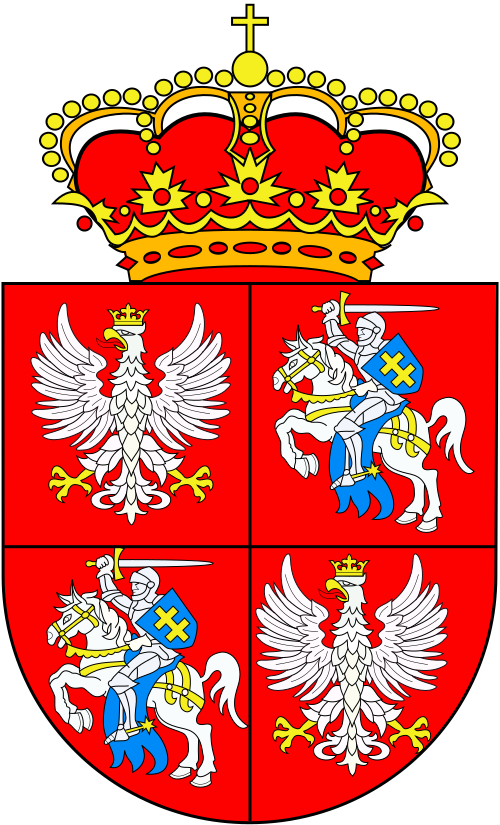
Coat of arms of the Polish-Lithuanian Commonwealth - this is general template, it does not consider form of Polish eagle from any real historical period
Coat of arms of the Polish-Lithuanian Commonwealth - this is general template, it does not consider form of Polish eagle from any real historical period (c. 2006) — Author: Olek Remesz (wiki-pl: Orem, commons: Orem). CC BY-SA 3.0.
Vasile Lupu — related to Battle of Finta (1653)
Vasile Lupu — related to Battle of Finta (1653) — Unknown. Public domain.
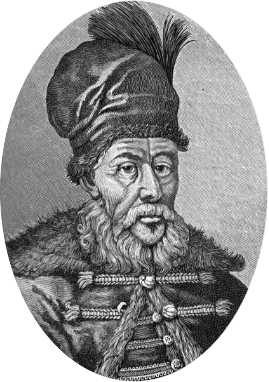
Matei basarab — related to Battle of Finta (1653)
Matei basarab — related to Battle of Finta (1653) — Unknown. Public domain.
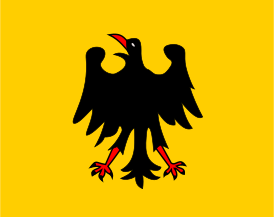
Reconstruction of the flag used by the German kings in the later medieval period (c. 12th to 14th centuries). The existence of such a flag is certain for the 14th century, likely for the 13th century,
Reconstruction of the flag used by the German kings in the later medieval period (c. 12th to 14th centuries). The existence of such a flag is certain for the 14th century, likely for the 13th century, (c. 1995) — Jaume Ollé; svg version by Masur. CC BY-SA 3.0.
Coat of arms of Bohdan and Yurii Chmelnitskyi
Coat of arms of Bohdan and Yurii Chmelnitskyi (c. 2007) — Alex Tora. Public domain.
Royal banner (not a flag) of the Polish-Lithuanian Commonwealth during the reign of the House of Vasa (1587-1668). Banner with three horizontal stripes of red, white and red. Coat of arms:1-4 Polish e
Royal banner (not a flag) of the Polish-Lithuanian Commonwealth during the reign of the House of Vasa (1587-1668). Banner with three horizontal stripes of red, white and red. Coat of arms:1-4 Polish e (c. 2008) — Olek Remesz (wiki-pl: Orem, commons: Orem). CC BY-SA 2.5.
Coat of arms of the Polish-Lithuanian Commonwealth - this is general template, it does not consider form of Polish eagle from any real historical period
Coat of arms of the Polish-Lithuanian Commonwealth - this is general template, it does not consider form of Polish eagle from any real historical period (c. 2006) — Author: Olek Remesz (wiki-pl: Orem, commons: Orem). CC BY-SA 3.0.
Vasile Lupu — related to Battle of Finta (1653)
Vasile Lupu — related to Battle of Finta (1653) — Unknown. Public domain.
Matei basarab — related to Battle of Finta (1653)
Matei basarab — related to Battle of Finta (1653) — Unknown. Public domain.
Reconstruction of the flag used by the German kings in the later medieval period (c. 12th to 14th centuries). The existence of such a flag is certain for the 14th century, likely for the 13th century,
Reconstruction of the flag used by the German kings in the later medieval period (c. 12th to 14th centuries). The existence of such a flag is certain for the 14th century, likely for the 13th century, (c. 1995) — Jaume Ollé; svg version by Masur. CC BY-SA 3.0.

Significance & Legacy

Led directly to Vasile Lupu's permanent ousting from Moldova and the installation of Gheorghe Ștefan. The battle demonstrated the limits of Cossack military power in the Romanian principalities and ended Lupu's bid for regional hegemony.

Frequently Asked Questions

When was the Battle of Finta?
The Battle of Finta took place in 1653. May 27, 1653.
Who won the Battle of Finta?
The Wallachia & Allies were victorious against the Moldavia & Cossacks.
What was the significance of the Battle of Finta?
Led directly to Vasile Lupu's permanent ousting from Moldova and the installation of Gheorghe Ștefan. The battle demonstrated the limits of Cossack military power in the Romanian principalities and ended Lupu's bid for regional hegemony.

Related Battles

Battle of Călugăreni1595 · Wallachia & Transylvanian Allies victoryBattle of Zărnești1690 · Ottoman Empire & Kuruc Rebels victoryBattle of Brașov1603 · Wallachia (Radu Șerban) victoryBattle of Obertyn1531 · Kingdom of Poland victoryBattle of Verbia1561 · Iacob Heraclid (Despot) & Olbracht Łaski victoryBattle of Jiliște1574 · Moldavia & Zaporozhian Cossacks victory
View all Early Modern Era battles →
Wikipedia (English)Wikidata← Back to Atlas