Battle of Războieni (Battle of Valea Albă)(1476)
Approximate site. The pin marks a locally accepted site or a nearby anchor point, not a survey-grade position.
Războieni commune, Neamț County — Războieni Monastery marks the site
Coordinate source: Wikipedia Battle of Valea Albă + Războieni GPS
Background
In 1475 the Ottoman's attempt to bring Moldova under their control, at winter by using an army of Rumelian local levies, ended disastrously with a defeat in the Battle of Vaslui. During the proper military campaign season, the Ottomans assembled a large army, estimated by contemporary western sources at about 90,000–150,000 soldiers, under the command of Sultan Mehmed II and entered Moldova in June 1476. Dennis Deletant and Keith Hitchins regard these numbers as accurate, Meanwhile, groups of Tartars from the Crimean Khanate (the Ottomans' recent ally) were sent to attack Moldova. According to Dennis Deletant and Keith Hitchins, they were repelled. But according to Shaw Stanford that joint Ottoman and Crimean Tatar forces "occupied Basarabia and took Akkerman, gaining control of the southern mouth of the Danube. Stephan tried to avoid open battle with the Ottomans by following a scorched-earth policy." In the process the Moldavians forces ended up being dispersed throughout the country, leaving only a small force of about 10,000–12,000 men, led by Stephen himself, to face the main Ottoman attack.
Campaign: Great Ottoman-Moldavian War 1475–1476
Forces Engaged

The Battle
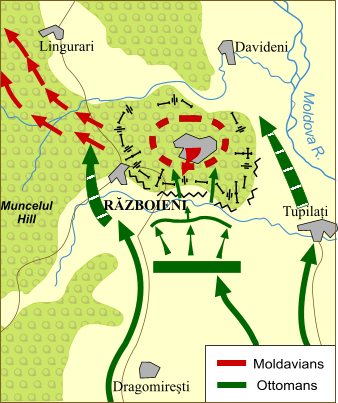
Mehmed II personally led a massive retaliatory invasion after Vaslui. Stefan's Moldavian force, weakened by plague and desertion, faced the full Ottoman army. Stefan fought a fighting retreat, then made a last stand at Războieni. The Moldavian army was shattered; Stefan fled north to his fortresses (Suceava, Neamț). The Ottomans could not take the fortresses and withdrew due to plague and supply failures.
The Battle of Valea Albă, also known as the Battle of Războieni or the Battle of Akdere, was an important event in the medieval history of Moldova. It took place at Războieni, also known as Valea Albă, on 26 July 1476, between the Moldavian army of Stephen the Great and an invading Ottoman army which was commanded personally by Sultan Mehmed the Conqueror.
“"Ştefan lost the battle but not the war. He built a monument — the church of Războieni — to the fallen. The Ottomans could not take his fortresses and withdrew in shame." — Romanian chronicle tradition
Casualties & Outcome
Moldavian army shattered: ~7,000 dead; Ottoman losses estimated 30,000 from battle and disease
Ottoman Empire achieved victory over Moldova.
Stephen retreated to the fortresses of Suceava and Neamț — neither fell. Plague and lack of provisions drove Mohammed away. Stephen reorganized his army within a few months and resumed campaigns in the fall.
Historical Record


Significance & Legacy
Stefan's greatest defeat in battle — but a strategic victory. Fortress resistance and disease stopped the Ottoman conquest of Moldova. Stefan rebuilt his army within months.
Frequently Asked Questions
- When was the Battle of Războieni (Battle of Valea Albă)?
- The Battle of Războieni (Battle of Valea Albă) took place in 1476. Jul 26, 1476.
- What was the outcome of the Battle of Războieni (Battle of Valea Albă)?
- The Ottoman Empire were victorious against the Moldova.
- What was the significance of the Battle of Războieni (Battle of Valea Albă)?
- Stefan's greatest defeat in battle — but a strategic victory. Fortress resistance and disease stopped the Ottoman conquest of Moldova. Stefan rebuilt his army within months.